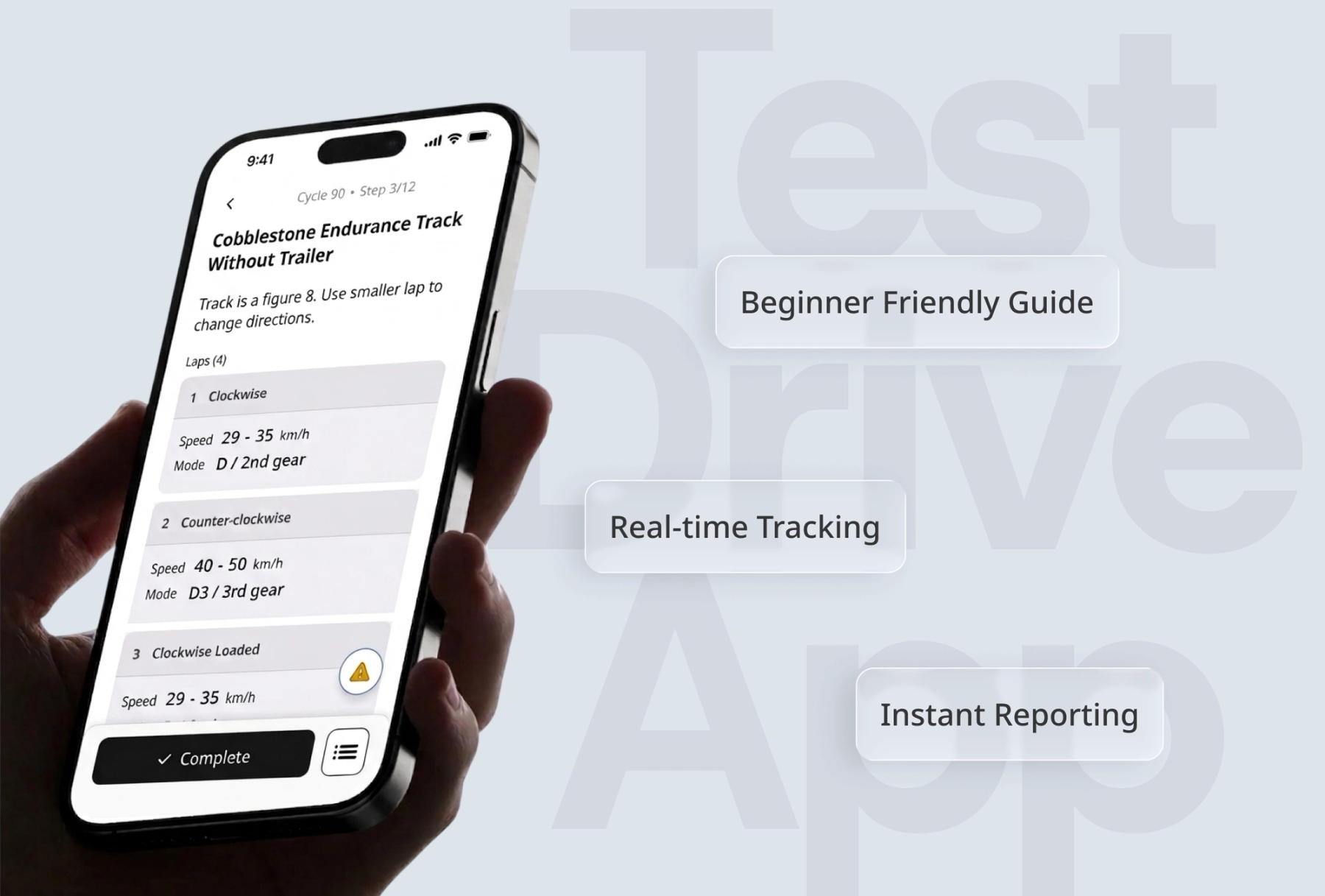
Note: Screens shown are recreations of the original 2021 designs. Test data has been replaced with placeholder content to protect Volvo's proprietary testing information, keeping the focus on the designed experience.
ContextBinders behind the wheel
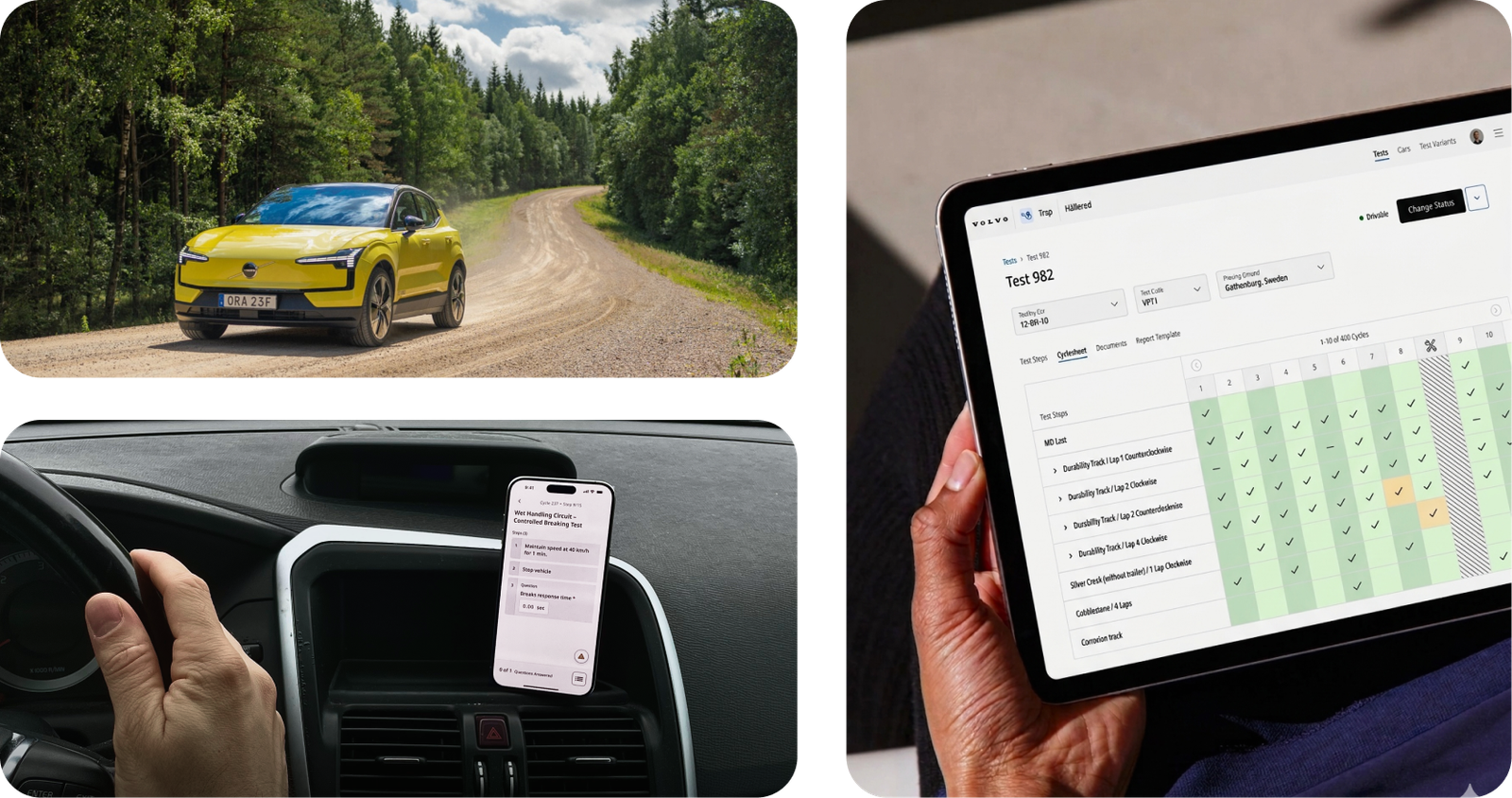
Vehicle manufacturers rely on test driving as a core part of safety and quality assurance. A test drive tasks a driver with evaluating a car's performance while following a predefined sequence of actions (referred to as cycles) on a controlled environment such as a test track.
These workflows are typically supported by extensive paper-based documentation — often binders of up to 100 pages — requiring drivers to flip through instructions while executing tests and later transfer results manually into digital systems.
Our team was approached to rethink this process and turn fragmented paperwork into a single digital solution, supporting both test drivers in the field as well as engineers managing the tests. As consultants, we worked in partnership with Volvo’s team responsible for digitising its internal workflows.
Role
I was the sole UX designer in a cross-functional team of developers, product owners and a delivery manager, shaping the experience from early exploration through to release.
- Delivered a coded proof of concept in one month, iterating through wireframes and live product feedback
- Took it through to release with engineering, solving edge cases, adding functionality and connecting the mobile app to the desktop tools
- Ran ongoing discovery with test engineers and experienced drivers to validate design decisions and edge cases
Business Value
The project was approved on a business case built around what the binders were costing Volvo in paper, time and data quality. Even a saving of ten minutes per driver per day was estimated to be worth over €100,000 a year.
- Less paper: no more printed binders or daily deviation sheets
- Faster start-up: less time preparing each test before it begins
- Faster execution: the right information at the right moment
OpportunityLowering barriers and improving performance
Discovery took place over daily sessions with test engineers, supervisors and a couple of highly experienced drivers. We analysed their test manuals and sheets, and brought every new idea or unclear edge case back to them for validation.
The clearest pattern came from senior test engineers, who kept returning to onboarding. Manuals were often long and difficult to navigate, especially for new drivers who were still learning the structure of each test cycle.
The binder's problems didn't end with the instructions. Results and errors recorded on paper had to be manually transferred into spreadsheets at the end of the day, adding unnecessary steps and increasing the risk of errors.
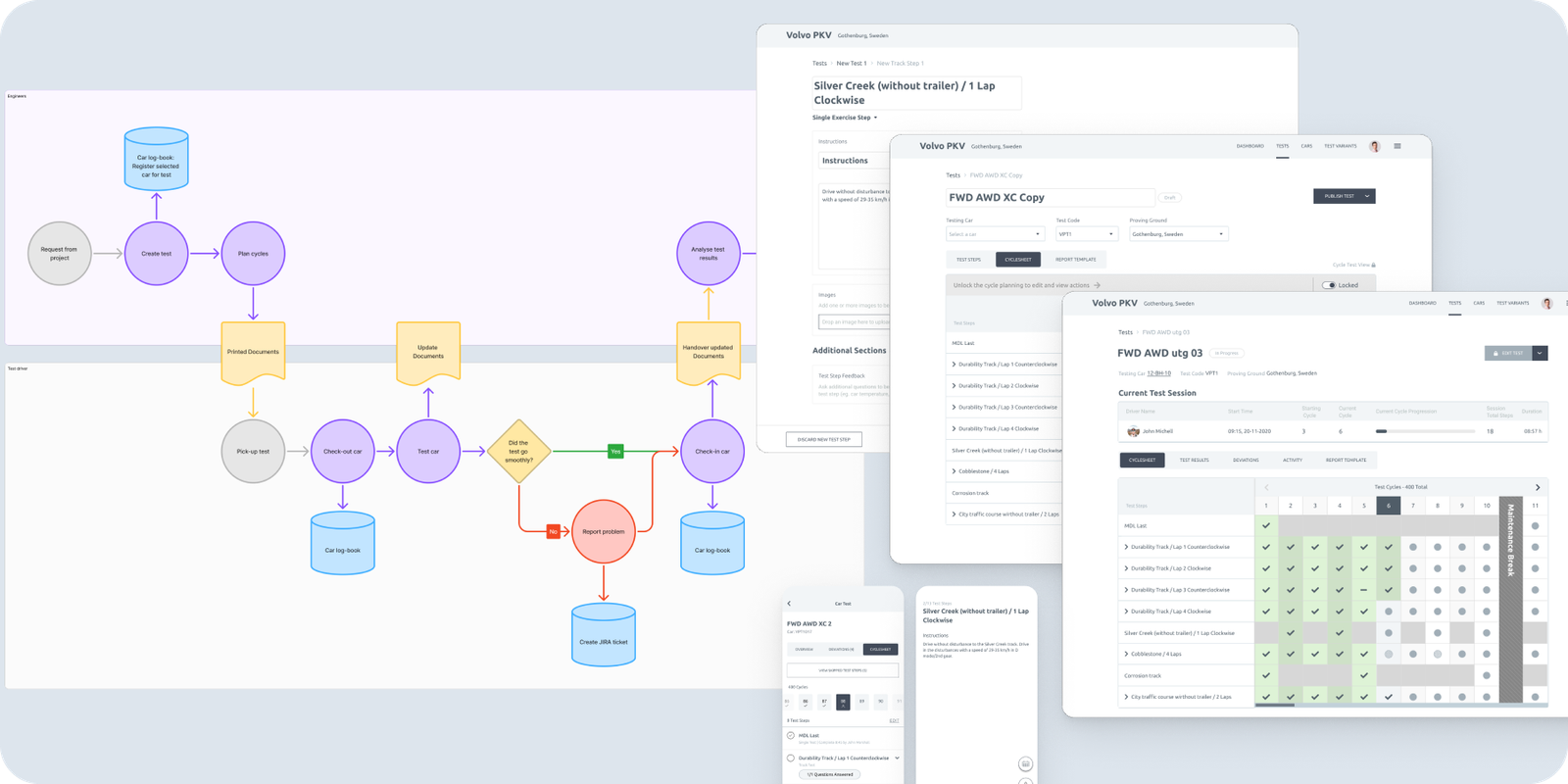
This project focused on simplifying and structuring that experience by:
- Replacing multiple paper documents with a single digital guide and record
- Lowering the learning curve for new test drivers while reducing friction for experienced testers alike
- Enabling engineers to track progress and results in real time
- Shortening the feedback loop between test execution and iteration
Design ApproachBuilt for the track and the desk
The solution combined a mobile experience for drivers with a desktop tool for test configuration and monitoring.
Building the test
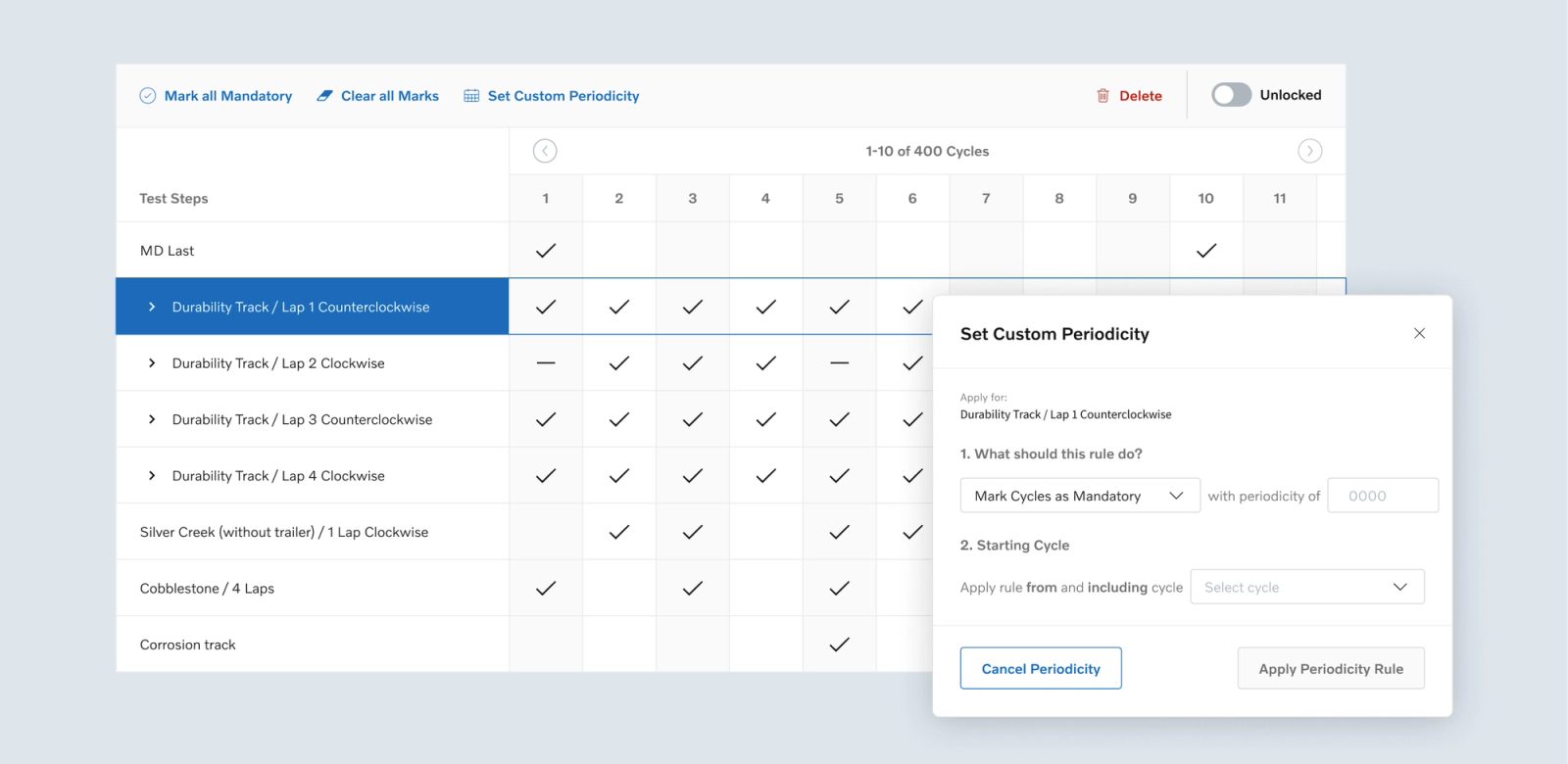
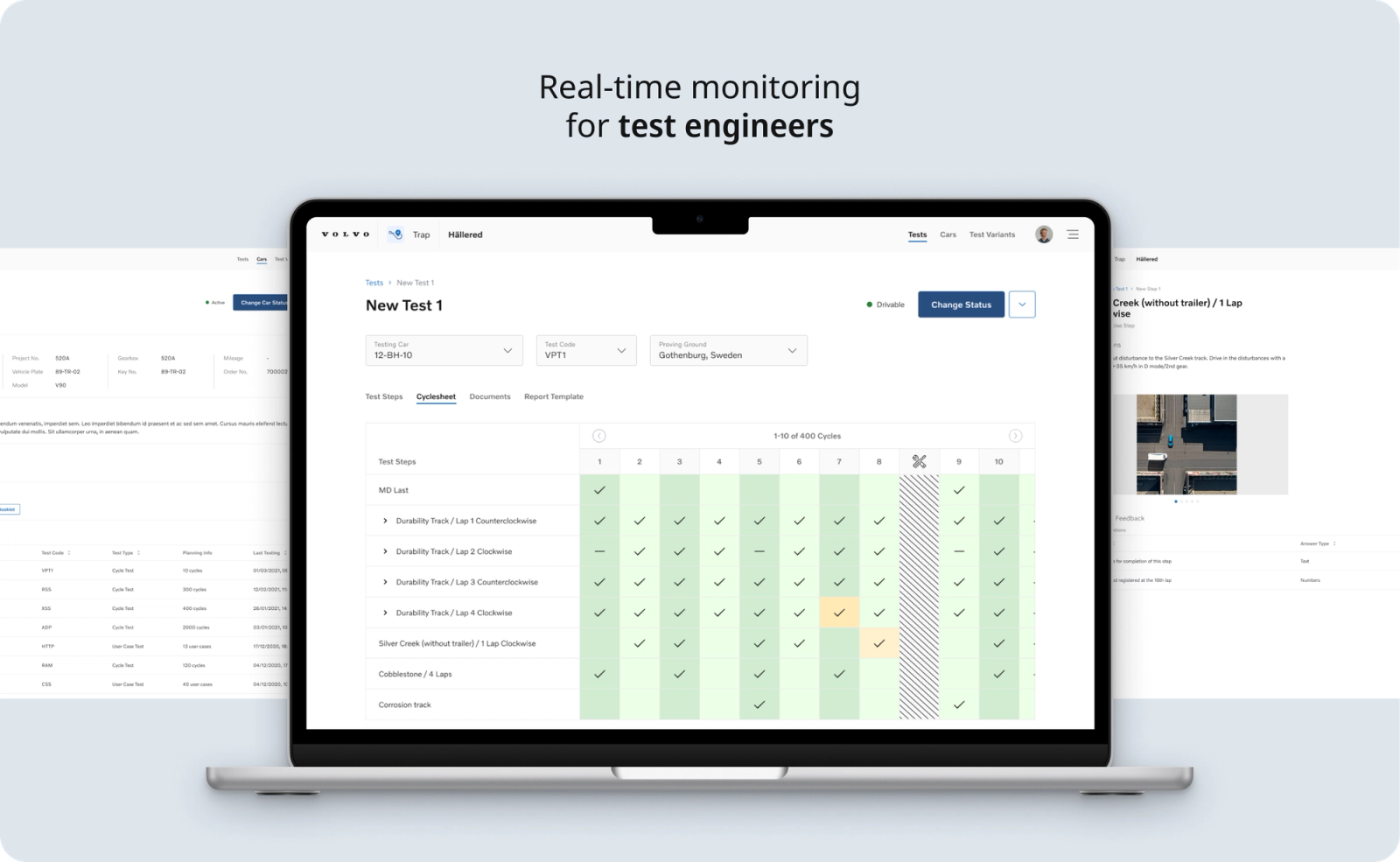
Before a driver can run a test, engineers need to build it. The desktop tool starts with a step library, where engineers create every test step a car might need, and a cycle sheet that works like a grid: each column is a cycle, up to a hundred of them, and each row is a step, checked for every cycle it belongs to. Quick actions handle the repetition, so a step that runs every five cycles can be set once instead of ticked by hand across the sheet.
Designing for the Driving Context
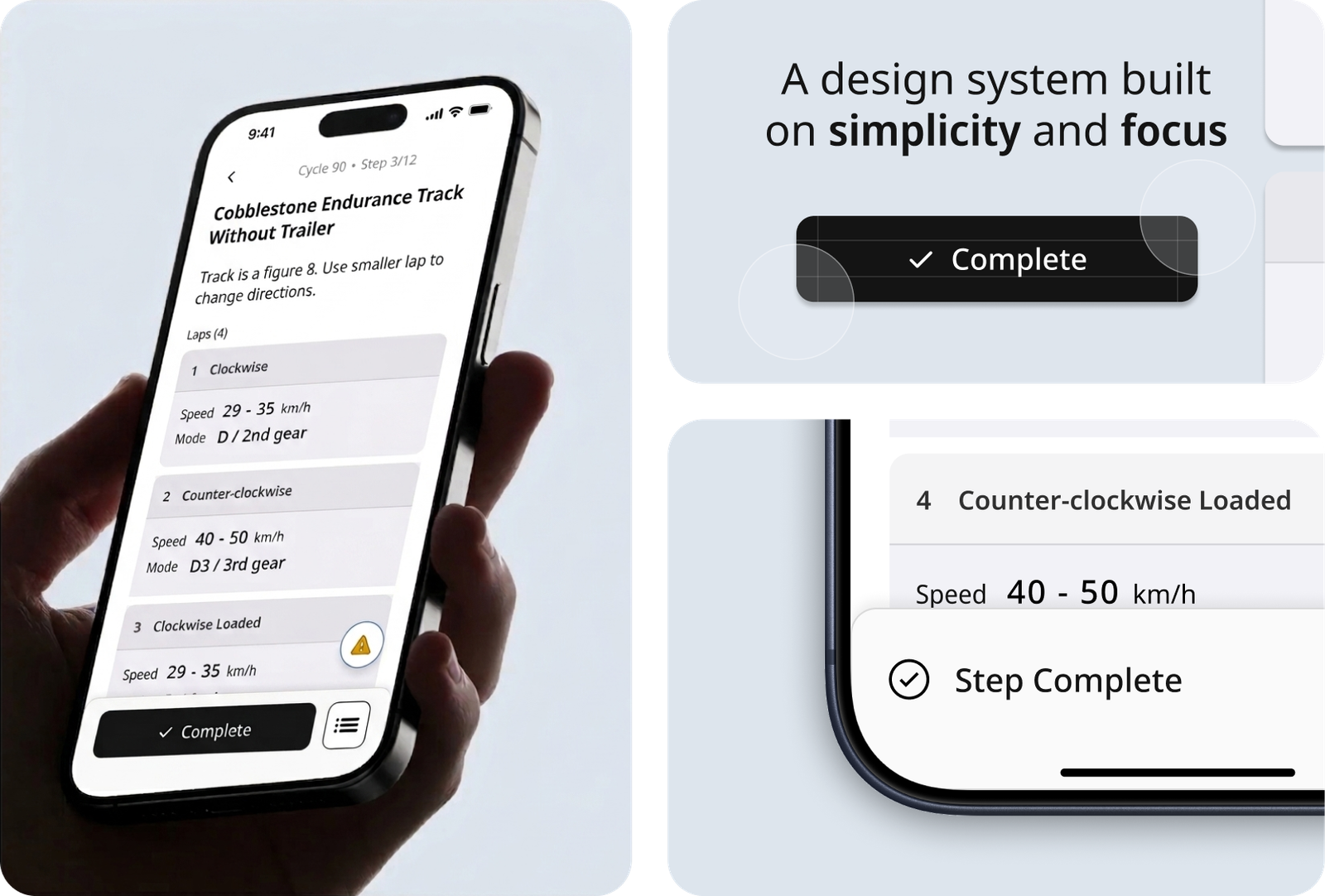
The interface was adapted for quick interaction in a physical environment. Drivers mark steps complete when stopped, but some instructions need rereading mid-step, so everything had to be readable at a glance. I tested text and button sizes by placing the phone at the same distance it would sit in the car, first in the office and then in my own car. One-handed testing also caught an early mistake: my first wireframes placed menu actions at the top of the screen, out of reach, so the primary actions moved to the bottom.
Guided flows for beginners, shortcuts for experts
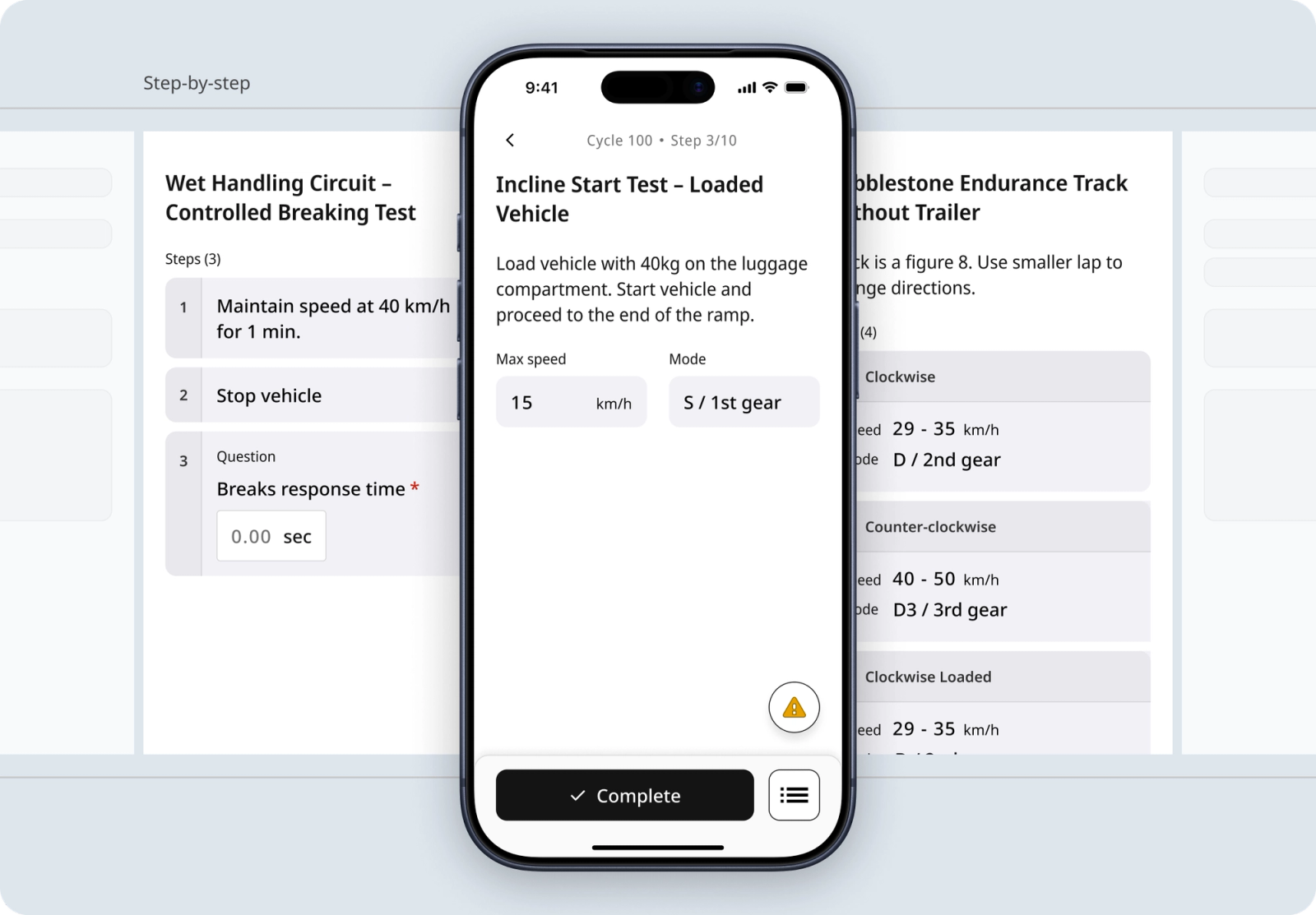
Beginner and experienced modes sit side by side rather than behind a setting. When starting a session, a driver chooses between the cycle sheet, an overview of every step in the cycle, and a step-by-step view that walks through one step at a time. Tapping any step opens its detail, and going back returns to the overview, so drivers can switch whenever the test calls for it.
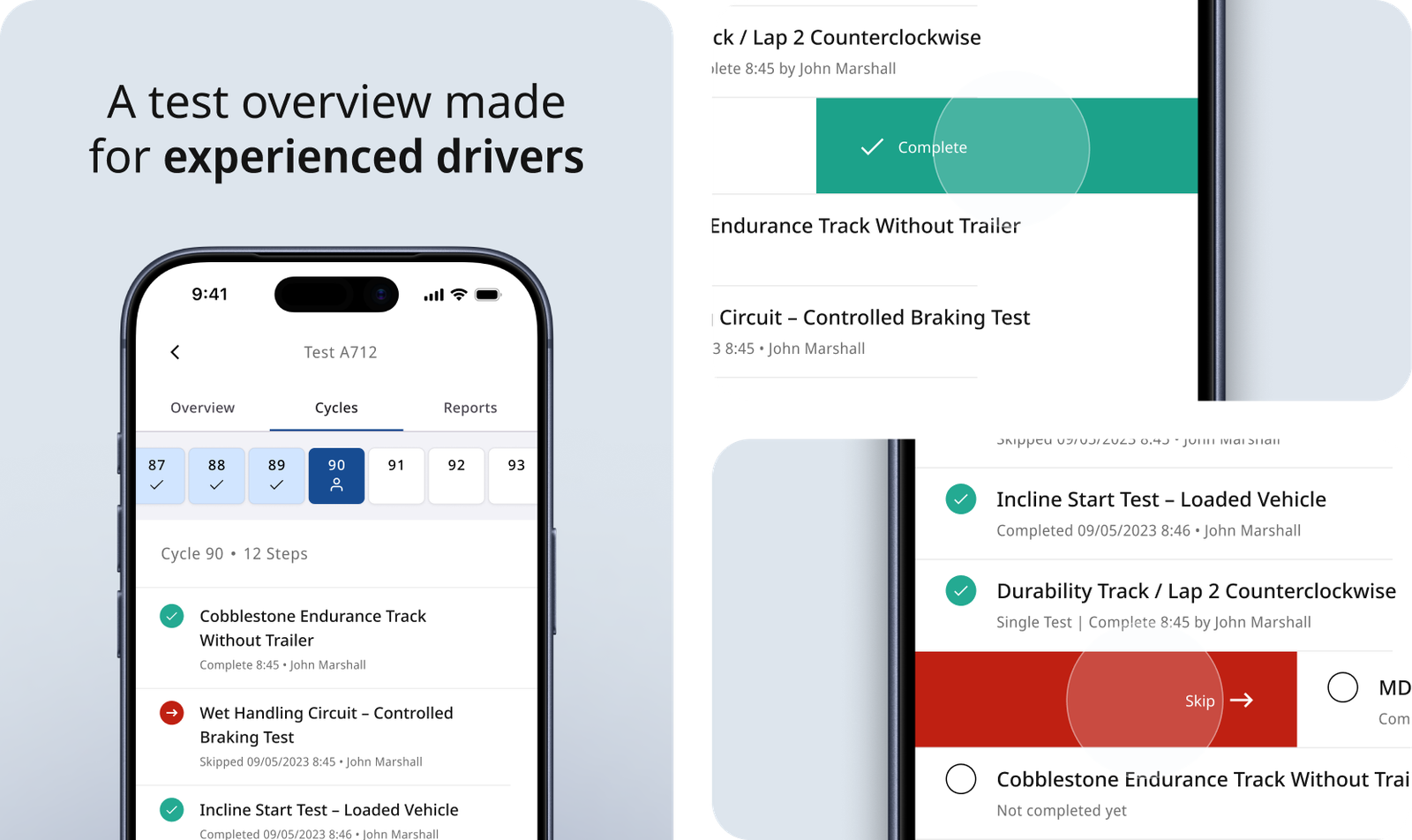
Experienced drivers know the sequence by heart and tend to run it end to end, marking the whole cycle complete at the finish. For everything in between, swiping a step left or right marks it complete or skipped, a shortcut that adds speed without adding clutter.
Real-Time Visibility
Engineers could monitor progress through a connected system: live test tracking, status updates per cycle and task, and a centralised overview of ongoing tests. What drivers logged on the track reached engineers as it happened.
Ideas we left behind
We explored showing test steps based on where a driver was on the track, but selecting steps in order had much the same effect, and steps tied to a location already named it, most with images. The added complexity didn't match the return on investment.
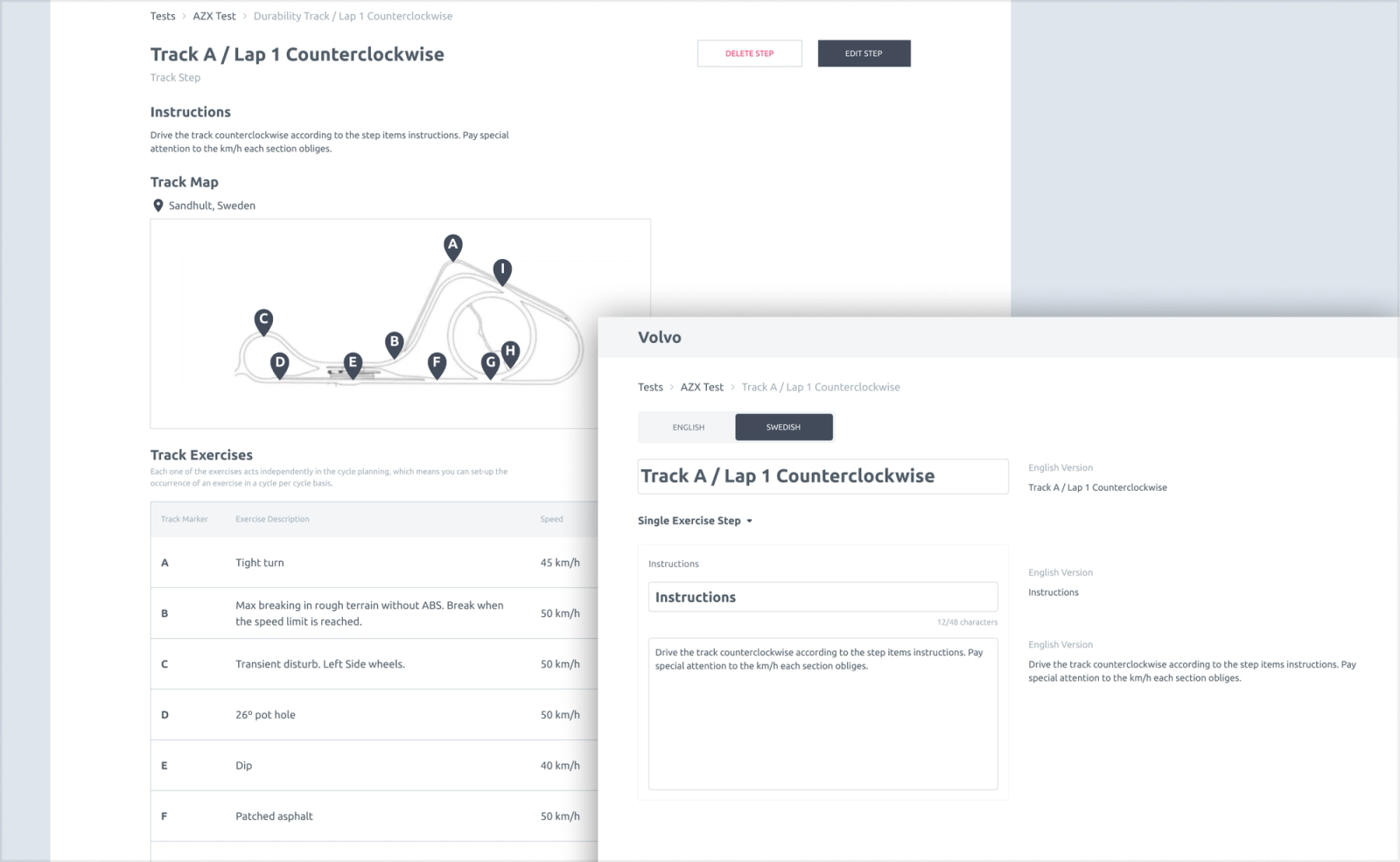
Early on we learned that Volvo runs proving grounds in several countries, so I explored letting engineers translate test steps in a side-by-side view with the English original. It was dropped for its complexity and because Volvo was committed to English as the shared language across its sites.
Impact38,700 fewer pages a year
What started as a coded proof of concept went on to replace the paper binders, taking roughly 38,700 printed pages a year out of the testing process.
- Paper out of the car: one app instead of a binder on the passenger seat
- Live results: no spreadsheet entry at the end of the day
- Richer records: deviations reported with photos and video, and every past test in one place
ClosingBeyond touch
By bringing instructions, execution and reporting into a single system, drivers could operate with greater clarity and efficiency, while engineers gained immediate visibility into test results, laying a foundation for more scalable, data-driven testing.
What I'd explore next
Looking back, I'd push further beyond touch. Voice control and text-to-speech could make steps faster to complete and instructions easier to follow while driving, and a dark mode would ease eye strain through long Swedish winters. None of these were priorities at the time, but they're where I'd take the product next.